Is the Baby Giraffe in Kc on Display?
The Giraffe (Giraffa camelopardalis meaning 'fast walking camel leopard) is an African even-toed ungulate mammal, the tallest of all land-living fauna species.
The giraffe is related to deer and cattle, even so, it is placed in a separate family, the Giraffidae, consisting but of the giraffe and its closest relative, the okapi.
The giraffes range extends from Chad to South Africa. Although the Okapi is much shorter than the giraffe, information technology also has a long neck and eats leaves and both animals have long tongues and skin-covered horns.
The giraffes ancestors outset appeared in central Asia about 15 one thousand thousand years ago, withal, the earliest fossil records of the giraffe itself, from State of israel and Africa, date back nigh ane.v 1000000 years.
Male person giraffes are called 'Bulls', female giraffes are called 'Cows' and infant giraffes are called 'Calves'.
Giraffe Characteristics
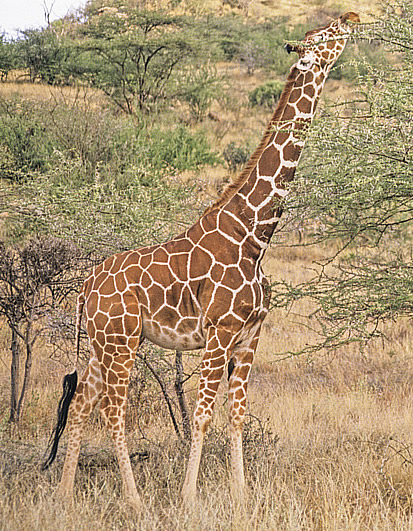
The giraffe is the tallest living animal which is instantly recognizable past its uncommonly long cervix. Adult males stand 15 – 19 anxiety (4.6 – vi.0 metres) alpine, whereas females are shorter at 13 – 16 feet (iv – 4.8 metres) tall. Adult males weigh between 1,764 – four,255 pounds (800 – 930 kilograms), while females weigh only 1,213 – 2,601 pounds (550 – 1,180 kilograms).
The giraffe has the longest tail of any state mammal. Their tail tin can abound to be 8 feet (2.four metres) long, including the tuft on the end.
In addition to its great height, the giraffe is also one of the heaviest land animals. Exceptionally big males may counterbalance up to 1,900 kilograms (about four,200 pounds).
Female giraffes are smaller, rarely reaching half that weight. Compared to other hoofed mammals the giraffe has a relatively brusque body, however, its legs are disproportionately long.
A giraffes front legs are nigh 10% longer than their hind legs, a feature that contributes to the animals steeply sloping back. Mature giraffes have large hooves near the size of dinner plates, around 12 inches wide.
Giraffe Habitat
Giraffes can inhabit savannas, grasslands or open woodlands. Giraffes prefer areas enriched with acacia growth (a genus of shrubs and copse). Most giraffes alive either in East Africa or in Republic of angola and Zambia in southwestern Africa. Until the middle of the 20th century giraffes were also commonly found in West Africa, south of the Sahara. But populations in that location accept fallen sharply and become increasingly fragmented.
Giraffe Diet
Giraffes alive in habitats where the available food varies throughout the year. During the dry flavor, giraffes eat evergreen leaves, yet, in one case the rainy season begins, they switch to new leaves and stems that sprout on deciduous trees. As well, twigs and branches are pulled into the rima oris of the giraffe with their long and dextrous tongues. In the wild giraffes can consume upward to 66 kilograms of food daily.
When in that location is a choice, male and female giraffes feed in different ways. Males concentrate on leaves from the highest branches, while the females arch their necks to eat closer to the ground. Because of this characteristic behaviour, a giraffe can be identified as either male or female person from a long distance abroad simply by its stance while eating. Male person giraffes are also more inclined to wander into dense woodland, a habitat that females generally avoid.
Giraffes drink large quantities of water and as a result, they tin spend long periods of time in dry, arid areas. When searching for more than food they will venture into areas with denser foliage. The giraffe has tough lips to ensure there is no damage to their mouths when chewing at trees and twigs such as thorns.
Giraffes in captivity are by and large fed on alfalfa hay and pellets, apples, carrots, bananas and browse (elm and alder are favourites).
Giraffe Behaviour
Female giraffes associate in groups of a dozen or and then members, occasionally including a few younger males. Male giraffes tend to live in bachelor herds, with older males ofttimes leading solitary lives. A individual giraffe tin bring together or leave the herd at any time and for no detail reason.
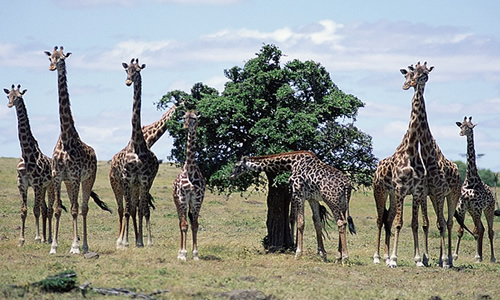
Because giraffes are and so widely scattered, it may seem that they do non keep in contact with each other, however, this is not truthful. A giraffes keen eyesight ways they tin go on an middle on their neighbours fifty-fifty at a distance.
Female giraffes spend just over half a 24 hour day browsing, male giraffes spend less time doing this – most 43% of the time that the female does. Dark is mostly spent lying down ruminating, especially in the hours after dark and earlier dawn.
Male person giraffes spend about 22% of the 24 hours walking, compared to thirteen% for female giraffes. The rest of the time male giraffes are searching for a female giraffe to mate with. Giraffe herds do not accept a leader and individual giraffes bear witness no particular preferences for others in the herd.
Immature giraffes are never left alone, nonetheless, they are looked after in a kind of nursery grouping where the females help wait after each others calves (baby giraffes).
Giraffes spend up to half their time feeding and well-nigh of the remainder is taken upwardly either by searching for nutrient or slowly digesting what they have eaten. Sometimes giraffes sleep during the daytime, often while standing.
Giraffes normally lie down simply at dark, tucking their feet under the body and usually keeping the caput upright. Even so, when a giraffe is sleeping, something it does only for just a few minutes at a time, it curves its neck around and rests its head on or near its behind.
One of the most fascinating elements of giraffe behaviour is the duel between males fighting for mating partners. Giraffe duels are amid the almost boggling in the animal kingdom. Duels begin when two males approach each other and engage in rubbing and intertwining their necks. This behaviour is known equally 'necking'. Information technology allows the opponents to assess each others size and force.
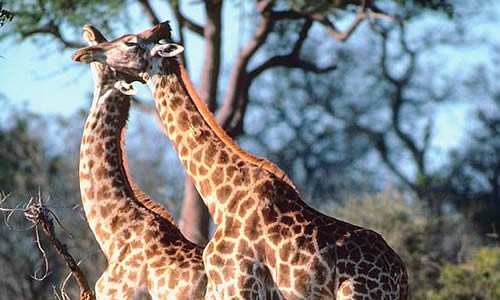
Ofttimes, necking alone is enough to establish say-so. If not, the rivals begin to exchange blows with their heads, using their brusque horns to tackle each other.
Each giraffe braces its front legs and swings its caput upward and over its shoulder. If a accident lands solidly, the giraffe may stagger under the impact and in rare cases may even collapse onto the basis. More than often the contest breaks off subsequently a few minutes and the loser but walks abroad.
Giraffe Reproduction
The Giraffe convenance flavor can occur at any fourth dimension during the yr. However, births in the wild usually happen during the dry flavour and births in captivity tin happen all year round. Giraffes attain sexual maturity in captivity at around three – 4 years old, all the same, in the wild, males practise non ordinarily breed until they are vi – seven years one-time. In contrast to the male person breeding age, females must be physically larger to deport offspring.
When male person giraffes are ready to breed, they begin the ritual combat over mates. Giraffes are not- territorial and a successful male giraffe will mate with receptive female giraffes whenever and wherever it finds them.
Gestation period is usually 13 – fifteen months and when a significant female giraffe is set up to requite nativity, she makes her way to a calving area that she volition use throughout her life. The moment of birth is dramatic, with the mother giraffe continuing on all fours and the calf tumbling onto the ground. Remarkably, the calf is rarely injured by its autumn.
Newborn giraffes are often on their feet within 20 minutes and are presently feeding on their mothers milk. Calves can walk most an 60 minutes after birth and can run within 24 hours of birth. Giraffe calves are about ii metres (6 feet) alpine at birth and weigh 104 – 154 pounds. Giraffe calves grow well-nigh 3 centimetres tall each day during the starting time calendar week and double their height in their commencement year.
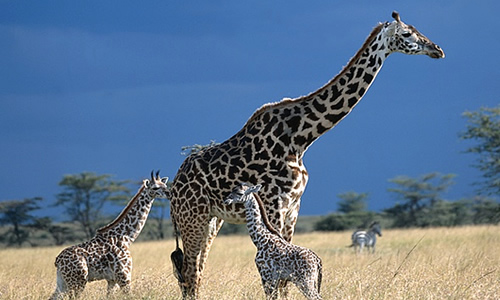
By the age of one year giraffe calves can mensurate 10 feet tall. Giraffe calves are weaned at one yr and get fully contained by xv months of age. Female giraffe calves are fully grown by age v and male giraffe calves by the age of seven.
Young giraffes may suckle for up to a year, however, they showtime to sample plants just a few weeks after nativity. Giraffe calves are ready to leave the protection of their mother after 15 – 18 months of development.
Developed giraffes more often than not accept no predators other than lions and humans, every bit their huge hooves are very effective in defending against predators. Giraffes are more vulnerable when they are lying downwards or drinking, because this gives lions the opportunity to jump up and seize them by the olfactory organ or throat.
Newly born calves are at much greater risk. Despite their mothers best efforts to protect them, over fifty percent of all giraffe newborns are killed by hyenas and large cats such every bit lions and leopards during the first month of their life. In captivity, giraffes have lived over the historic period of 30 years, all the same, their maximum life span in the wild is about 25 years.
Giraffe Sounds
Giraffes are usually silent although they can bellow, grunt or snort when alarmed, every bit when confronted by lions, and can as well moo in distress.
Hold your mouse over the giraffe photo and yous may be able to hear a giraffe grunt. (ie only)
Calves (young giraffes) bleat and make a mewing call, cows (female person giraffes) seeking lost calves will bellow and courting bulls (male giraffes) may emit a raucous coughing. Giraffes too give alarm snorts, whereby moaning, snoring, hissing and flute like sounds have been reported. Giraffes also requite out a grunting sound that sounds similar a pig.
Giraffe Adaptions
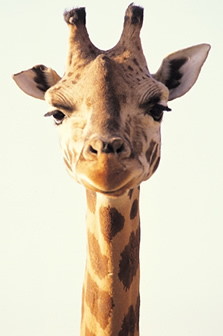
Giraffes have amazing adaptions that assistance them with their lifestyle in the wild. Considering giraffes grow to a very tall height, it gives them access to a level of leafage beyond reach of all other big browsing animals all except possibly, the elephant.
Forth with their elevation, giraffes accept an incredible array of adaptations. For example, their skin colouring provides excellent camouflage, equally it has many different patches of variable size and color.
Giraffes skin is very thick, so it provides ample protection and insulation. Also, the giraffe's long eyelids keep out ants and sense thorns on the branches of the trees from which they browse. The valves in veins of the neck command a huge rush of blood to the caput when leaning over; this prevents unconsciousness.
There is as well a network of capillaries in the encephalon called the 'wonder-internet'. Information technology acts rather similar a shock absorber and is another part of the organization that prevents unconsciousness. (Also see 'Giraffe Beefcake' for more facts almost the giraffes neck).
A giraffes tongue is over eighteen inches (46 centimetres) long, and the roof of the mouth is grooved to easily strip leaves off branches. Since giraffes are extremely efficient at processing nutrients and liquids from food, they can survive without h2o for long periods of time. Giraffes ruminate mean solar day or night, with periods of slumber in betwixt.
Giraffes also balance with their eyes open up, standing or lying for three to five minutes at a time. Throughout the nighttime, a giraffe may deeply sleep for five to 10 minutes lying downwards, withal they rarely sleep more than than 20 minutes total per solar day.
Giraffe Conservation Condition
Like many of Africas large mammals, giraffes take declined in numbers and in range over the concluding century. At one time, herds of over 100 animals were common in savanna regions across the continent, even so, today concentrations like these be only in East Africa specially Tanzania Serengeti National Park.
The decline of giraffe populations has largely been due to hunting. In Africa, the giraffe is a traditional source of hide and hair and too of tough simply nutritious meat. Hunting of giraffes has not however had a catastrophic issue, as it has on some of Africas big-game animals, but it is a cause for concern. The natural habitat of the giraffe is too existence impacted more than and more by man activities, reducing the animals range.
The giraffe is currently a protected species throughout about of its range and is classed equally conservation-dependent by the World Conservation Union (IUCN). The giraffes prospects for survival are good for those living in national parks and game reserves, but for animals living outside these areas the future is less secure.
Giraffe FAQs
How tall is a giraffe?
The giraffe is the tallest living brute on state. Fully grown giraffes stand up four.3 to 5.7 m (14.1 to eighteen.7 ft) alpine, with males taller than females. Despite its long neck and legs, the giraffe'due south torso is relatively short.
A giraffe's neck can be upward to two.4 m (seven.9 ft) in length. It results from a disproportionate lengthening of the cervical vertebrae, not from the addition of more vertebrae. Each cervical vertebra is over 28 cm (xi in) long. The giraffe's elongation of the cervix largely takes place subsequently nativity, because giraffe mothers would have a difficult time giving nascence to young with the same cervix proportions every bit adults.
It has been suggested that competitive pressure level from smaller browsers, like kudu, steenbok and impala, encouraged the elongation of the giraffe'due south neck, as it enabled giraffes to reach nutrient that competitors could not. Giraffes can feed up to 4.5 m (15 ft) high.
What sound does a giraffe make?
Early biologists suggested giraffes were mute and unable to produce air flow of sufficient velocity to vibrate their vocal folds. Yet, they have been recorded communicating using snorts, sneezes, coughs, snores, hisses, bursts, moans, grunts, growls and flute-like sounds. During nighttime, giraffes appear to hum to each other higher up the infrasound range.
During courtship, males emit loud coughs. Females besides phone call their young by bellowing. Calves will emit snorts, bleats, mooing and mewing sounds.
How long does a giraffe live?
Giraffes have an unusually long lifespan compared to other ruminants, and tin can alive to up to 38 years. Adult giraffes are not usually preyed on because of their size, eyesight and powerful kicks, however, lions tin can casualty on smaller individuals and giraffes are a common food source for big cats. Adult females are a lot more likely to survive if the group in which they socialize is bigger.
Giraffe calves are much more than vulnerable than adults and are also preyed on by leopards, spotted hyenas and wild dogs. A quarter to a half of giraffe calves reach adulthood. Calves born during the dry season have higher survival rates.
What do giraffes swallow?
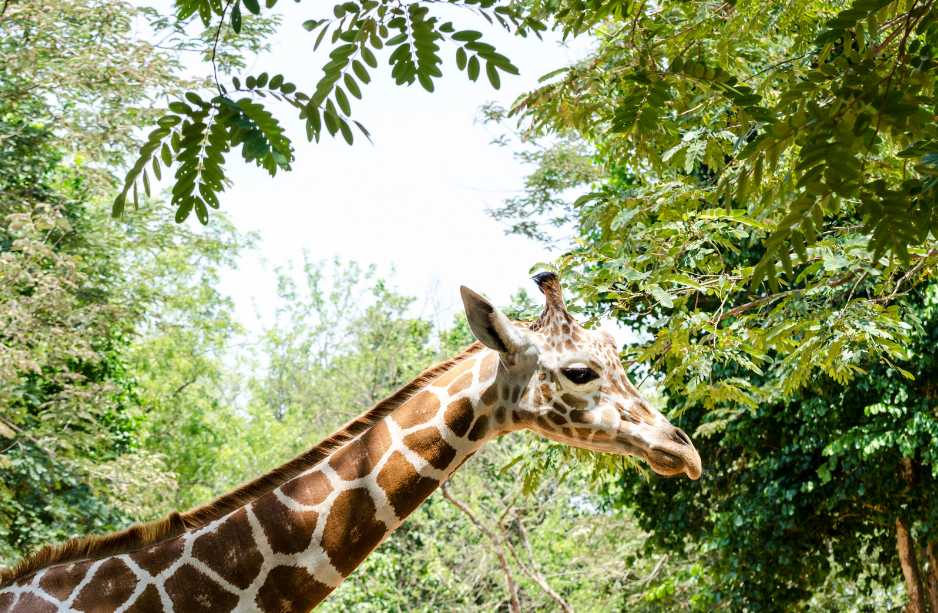
Giraffes are herbivores and are known to eat up to sixty different species of establish. They most commonly swallow from acacia trees only also browse for wild apricots, flowers, fruits and buds along with eating seeds and fresh grass just afterwards the rains. When stressed, giraffes may chew the bark off branches.
A giraffe eats around 34 kg (75 lb) of foliage daily. They more often than not eat during the first and last hours of daytime. They go 70% of their moisture from their food so need to beverage very niggling. In fact, they tin survive for up to three weeks without drinking water. However, when they do come across clean water, they must splay their front end legs (which are longer than the back) in order to get their head close enough to the ground to drinkable.
Giraffe requires less nutrient than many other herbivores considering the foliage it eats has more than full-bodied nutrients and it has a more efficient digestive system. As a ruminant, giraffes first chew food, then swallow it for processing then visibly passes the half-digested cud up the neck and dorsum into the mouth to chew again.
Their height helps them to reach branches and leaves that other animals cannot. Competition for food is idea to exist the primary reason why their necks are then long. They utilise their prehensile lips and flattened, grooved teeth are able to strip the leaves off the branches.
How do giraffes sleep?
Giraffes normally sleep lying down, although standing sleeps have been recorded, particularly in older individuals. In captivity, a giraffe sleeps intermittently around 4.half-dozen hours per day, mostly at night, but in the wild they tin can slumber as footling as 5 to 30 minutes in a 24 hr catamenia. The most common corporeality of sleep for giraffes is between one and two hours.
Giraffes as well go through intermittent short "deep sleep" phases. These are characterised by the giraffe bending its cervix backwards and resting its caput on the hip or thigh.
Where practice giraffes live?
Giraffes are native to Kenya, Republic of cameroon, Chad, Niger, Uganda, Namibia, Republic of botswana, Zimbabwe, Zambia, Tanzania, Angola, and S Africa. They were originally establish in over 20 African nations but are now extinct in 7 nations – Burkina Faso, Eritrea, Guinea, Mali, Mauritania, Nigeria and Senegal. Almost giraffes alive in East Africa, although some are found in the reserves of Southern Africa. The largest concentration of these animals are plant in National Parks.
The different subspecies of giraffe alive in different countries in Africa, but certain species have failing populations in areas, mostly due to habitat loss and poaching. The Uganda giraffe historically lived in western Republic of kenya, Uganda, and southern Sudan, but now survives in only a few minor, isolated populations in Kenya and Uganda. The Nigerian giraffe is now found in just one expanse of Niger. The reticulated giraffe lives in Somalia, southern Ethiopia, and northern Republic of kenya.
Giraffes usually inhabit savannahs and woodlands, where there are large amounts of foliage for them to feed on. Their coloring helps them to alloy in with their surroundings, but they are so large that they are safer in numbers instead of trying to hide.
Considering giraffes feed on vegetation that is loftier in the trees but also too woody for the mouths of smaller herbivores, they are also able to remain in areas where domestic grazing has obliterated the establish species close to the ground.
What is a grouping of giraffes chosen?
A group of giraffes is chosen a tower! Giraffes are social animals and are usually constitute in groups, oft called herds. The groups vary in size and composition, but tin can range in size from one to upward to 66 individuals! Giraffe towers tend to be sex-segregated, although mixed-sexual practice groups made of developed females and young males also occur.
Females are more selective about who they associate with from the opposite sex, and many herds are made upwards of mothers and their immature. Equally they get older, males become more solitary but may also acquaintance in pairs or with female groups.
How does a giraffe move?
Giraffes accept ii means of moving, a loping walk and a gallop. When they walk, the giraffes motility both feet on one side of their trunk in unison, followed by both feet on the other side. When they run, giraffes move the front feet together, and so the back feet, swinging the hind feet up and planting them in front of the forefeet. While running, the cervix of a giraffe moves astern and forrard to keep the animate being counterbalanced. Giraffes have a peak speed of about 56 kilometres per hour (35 miles per 60 minutes), however, because its legs are so long a galloping giraffe does non appear to exist going very fast.
Giraffes are non great travelers, despite their long legs. Giraffes cannot walk over swampy ground because their hooves quickly sink and they very rarely wade beyond rivers. Giraffes on opposite banks of a river may never come into contact, unless the water levels drop.
How does a giraffe bend downwards?
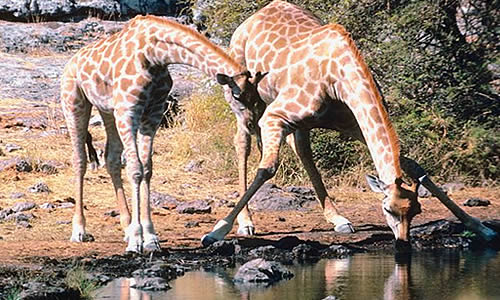
For giraffes, bending down is a daily claiming. To accomplish footing level for example, when drinking a giraffe has to splay its front legs at an angle of almost 45 degrees.
A giraffes circulatory system is also specially modified, because the loftier pressure needed to pump blood up to its caput could cause brain damage when the head is lowered. To deal with this trouble, giraffes have elastic blood vessels that salvage some of the excess pressure level.
Giraffes also have a series of valves in their neck veins that ensure that blood always flows from the head dorsum towards the heart, fifty-fifty when this means going against gravity.
When giraffes do curve down to drink at water holes, it is commonly done in pairs. This is so that one giraffe can drinkable, whilst the other keeps an eye open for predators.
Source: https://animalcorner.org/animals/giraffe/
0 Response to "Is the Baby Giraffe in Kc on Display?"
ارسال یک نظر