America Land I Love Section 32 Review Charter Oak
The Canadian Charter of Rights and Freedoms (French: La Charte canadienne des droits et libertés), oft simply referred to as the Charter in Canada, is a bill of rights entrenched in the Constitution of Canada, forming the offset function of the Constitution Human activity, 1982. The Lease guarantees certain political rights to Canadian citizens and civil rights of anybody in Canada from the policies and deportment of all areas and levels of the government. It is designed to unify Canadians effectually a set of principles that embody those rights. The Charter was signed into law past Queen Elizabeth 2 of Canada on April 17, 1982, along with the residuum of the Constitution Act, 1982.
The Charter was preceded by the Canadian Bill of Rights, enacted in 1960, which was only a federal statute rather than a constitutional certificate. As a federal statute, the Bill could exist amended through the ordinary legislative process and had no application to provincial laws. The Supreme Court of Canada besides narrowly interpreted the Bill of Rights, showing reluctance to declare laws inoperative.[a] The relative ineffectiveness of the Canadian Bill of Rights motivated many to meliorate rights protections in Canada. The move for man rights and freedoms that emerged after Earth War II also wanted to entrench the principles enunciated in the Universal Declaration of Human Rights.[1] The British Parliament formally enacted the Lease as a part of the Canada Act 1982 at the request of the Parliament of Canada in 1982, the event of the efforts of the regime of Prime Minister Pierre Trudeau.
The Charter profoundly expanded the scope of judicial review, because the Charter is more explicit with respect to the guarantee of rights and the role of judges in enforcing them than was the Bill of Rights. The courts, when confronted with violations of Lease rights, have struck downward unconstitutional federal and provincial statutes and regulations or parts of statutes and regulations, as they did when Canadian case law was primarily concerned with resolving problems of federalism. The Charter, however, granted new powers to the courts to enforce remedies that are more creative and to exclude more evidence in trials. These powers are greater than what was typical under the common law and under a organisation of government that, influenced past Canada'southward parent state the United Kingdom, was based upon Parliamentary supremacy. Every bit a result, the Charter has attracted both wide support from a bulk of the Canadian electorate and criticisms by opponents of increased judicial ability. The Charter simply applies to government laws and actions (including the laws and actions of federal, provincial, and municipal governments and public school boards), and sometimes to the common law, not to private activity.
Features [edit]
Under the Charter, people physically present in Canada have numerous civil and political rights. Nearly of the rights can be exercised by whatsoever legal person (the Charter does not define the corporation as a "legal person"),[one] : 741–2 simply a few of the rights vest exclusively to natural persons, or (as in sections 3 and half-dozen) only to citizens of Canada. The rights are enforceable past the courts through section 24 of the Charter, which allows courts discretion to award remedies to those whose rights have been denied. This section besides allows courts to exclude testify in trials if the evidence was caused in a way that conflicts with the Lease and might impairment the reputation of the justice system. Section 32 confirms that the Charter is binding on the federal government, the territories nether its authority, and the provincial governments.
Exceptions [edit]
Department ane of the Lease, known every bit the limitations clause, allows governments to justify sure infringements of Charter rights. If a court finds that a Charter right has been infringed, information technology conducts an analysis under section ane past applying the Oakes exam, a class of proportionality review. Infringements are upheld if the government's objective in infringing the right is "pressing and substantial" in a "free and democratic society", and if the infringement can be "demonstrably justified".[two] The Supreme Court of Canada has applied the Oakes examination to uphold laws against hate speech (eastward.k., in R 5 Keegstra) and obscenity (e.g., in R v Butler). Section one as well confirms that the rights listed in the Charter are guaranteed.
In addition, some Charter rights are subject to the notwithstanding clause (department 33). The nonetheless clause authorizes governments to temporarily override the rights and freedoms in sections 2 and 7 through fifteen for up to five years, subject to renewal. The Canadian federal government has never invoked it, and some take speculated that its use would be politically plush.[3] In the past, the notwithstanding clause was invoked routinely by the province of Quebec (which did non support the enactment of the Charter merely is subject to information technology withal). The provinces of Saskatchewan and Alberta accept besides invoked the even so clause, to end a strike and to protect an exclusively heterosexual definition of matrimony,[4] [b] respectively. The territory of Yukon also passed legislation one time that invoked the still clause, just the legislation was never proclaimed in force.[6]
Rights and Freedoms [edit]
The rights and freedoms enshrined in 34 sections of the Charter include:
Primal freedoms [edit]
- Section 2
- lists what the Charter calls "fundamental freedoms" namely freedom of conscience, liberty of religion, liberty of thought, liberty of belief, freedom of expression, freedom of the printing and of other media of communication, freedom of peaceful associates, and freedom of clan. In instance law, this clause is cited as the reason for the religious neutrality of the state.
Democratic rights [edit]
Generally, the correct to participate in political activities and the right to a autonomous form of authorities are protected:
- Section 3
- the correct to vote and to be eligible to serve as member of the Firm of Commons of Canada and provincial and territorial legislative assemblies.
- Section four
- the maximum elapsing of the Business firm of Commons and legislative assemblies is gear up at 5 years.
- Section 5
- an annual sitting of Parliament and legislatures is required.
Mobility rights [edit]
- Section six
- protects the mobility rights of Canadian citizens which include the right to enter, remain in, and leave Canada. Citizens and Permanent Residents have the ability to motility to and have up residence in any province to pursue gaining livelihood.
Legal rights [edit]
Rights of people in dealing with the justice system and police enforcement are protected:
- Section 7
- right to life, liberty, and security of the person.
- Section 8
- freedom from unreasonable search and seizure.
- Section 9
- liberty from arbitrary detention or imprisonment.
- Section 10
- right to legal counsel and the guarantee of habeas corpus.
- Section 11
- rights in criminal and penal matters such as the right to be presumed innocent until proven guilty.
- Section 12
- right not to be subject to cruel and unusual penalization.
- Section 13
- rights against cocky-incrimination.
- Department xiv
- right to an interpreter in a court proceeding.
Equality rights [edit]
- Section fifteen
- equal treatment before and under the law, and equal protection and benefit of the law without discrimination.
Language rights [edit]
Generally, people accept the right to use either the English language or French language in communications with Canada'southward federal government and certain provincial governments. Specifically, the language laws in the Charter include:
- Section sixteen
- English and French are the official languages of Canada and New Brunswick.
- Section 16.i
- the English and French-speaking communities of New Brunswick have equal rights to educational and cultural institutions.
- Section 17
- the correct to utilise either official linguistic communication in Parliament or the New Brunswick legislature.
- Section 18
- the statutes and proceedings of Parliament and the New Brunswick legislature are to be printed in both official languages.
- Section nineteen
- both official languages may be used in federal and New Brunswick courts.
- Section 20
- the correct to communicate with and be served past the federal and New Brunswick governments in either official language.
- Section 21
- other constitutional language rights outside the Lease regarding English language and French are sustained.
- Section 22
- existing rights to use languages too English and French are non affected by the fact that only English and French have language rights in the Charter. (Hence, if there are any rights to use Ancient languages anywhere they would keep to exist, though they would have no straight protection under the Lease.)
Minority linguistic communication education rights [edit]
- Section 23
- rights for sure citizens belonging to French and English speaking minority communities to have their children educated in their ain language.
Other sections [edit]
Various provisions help to analyze how the Lease works in exercise, including:
- Section 25
- states that the Charter does non derogate existing Aboriginal rights and freedoms. Aboriginal rights, including treaty rights, receive more direct ramble protection under section 35 of the Constitution Human action, 1982.
- Section 26
- clarifies that other rights and freedoms in Canada are not invalidated past the Charter.
- Department 27
- requires the Lease to exist interpreted in a multicultural context.
- Section 28
- states all Charter rights are guaranteed equally to men and women.
- Section 29
- confirms the rights of dissever schools are preserved.
- Section thirty
- clarifies the applicability of the Charter in the territories.
- Section 31
- confirms that the Lease does not extend the powers of legislatures.
- Section 34
- states that Function I of the Constitution Human activity, 1982, containing the first 34 sections of the Human action, may be collectively referred to as the "Canadian Lease of Rights and Freedoms".
History [edit]
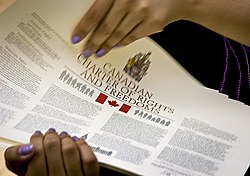
Printed copies of the Canadian Charter of Rights and Freedoms
Many of the rights and freedoms that are protected nether the Charter, including the rights to freedom of spoken language, habeas corpus, and the presumption of innocence,[vii] have their roots in a ready of Canadian laws and legal precedents[8] sometimes known as the Implied Beak of Rights. Many of these rights were besides included in the Canadian Nib of Rights (CBR), which the Canadian Parliament enacted in 1960. Nevertheless, the CBR had a number of shortcomings. Different the Lease, it was an ordinary Act of Parliament, applicative simply to the federal government, and could be amended by a simple majority of Parliament. Moreover, the courts chose to interpret the CBR but sparingly, and only on rare occasions practical it to find a contrary law inoperative. Additionally, CBR did not contain all of the rights that are now included in the Charter, omitting, for instance, the correct to vote[9] and freedom of move within Canada.[ten]
The centennial of Canadian Confederation in 1967 aroused greater interest inside the government in constitutional reform. Such reforms would not only meliorate the safeguarding of rights, merely would likewise amend the Constitution to gratis Canada from the potency of British Parliament (also known every bit patriation), ensuring the full sovereignty of Canada. Subsequently, Attorney General Pierre Trudeau appointed law professor Barry Strayer to research a potential bill of rights. While writing his report, Strayer consulted with a number of notable legal scholars, including Walter Tarnopolsky. Strayer's written report advocated a number of ideas that would after exist axiomatic in the Lease, including the protection of linguistic communication rights; exclusion of economic rights; and the allowance of limitations on rights, which would be included in the Charter 'south limitation and nonetheless clauses.[11] In 1968, Strayer was made the director of the Constitutional Law Partition of the Privy Council Part, followed in 1974 by his appointment every bit assistant deputy Government minister of Justice. During these years, Strayer played a role in writing the bill that was ultimately adopted.
Constitution Deed, 1982 [edit]
Meanwhile, Trudeau, who had become Liberal leader and prime minister in 1968, still very much wanted a constitutional neb of rights. The federal and provincial governments discussed creating i during negotiations for patriation, resulting in the Victoria Charter in 1971, which was never implemented. Trudeau continued his efforts, nevertheless, promising constitutional modify during the 1980 Quebec referendum. He succeeded in 1982 with the passage of the Canada Human activity 1982 in the British Parliament, which enacted the Constitution Human action, 1982 as part of the Constitution of Canada.

The inclusion of a charter of rights in the Constitution Human action was a much-debated consequence. Trudeau spoke on tv set in Oct 1980,[12] where he appear his intention to constitutionalize a bill of rights that would include: fundamental freedoms, such as the freedom of motion; democratic guarantees; legal rights; language rights; and equality rights.[xiii] : 269 Yet, Trudeau did not desire a yet clause.[discuss] While his proposal gained popular support,[xiii] : 270 provincial leaders opposed the potential limits on their powers. The federal Progressive Conservative opposition feared liberal bias among judges, should courts exist called upon to enforce rights.[xiii] : 271 Additionally, the British Parliament cited their right to uphold Canada's sometime form of government.[13] : 272 At a proffer of the Conservatives, Trudeau's regime thus agreed to a committee of senators and members of Parliament (MPs) to further examine the bill as well equally the patriation plan. During this time, 90 hours were spent on the bill of rights alone, all filmed for television, while ceremonious rights experts and advocacy groups put forward their perceptions on the Charter 's flaws and omissions and how to remedy them.[13] : 270 Equally Canada had a parliamentary system of government, and as judges were perceived not to have enforced rights well in the past, it was questioned whether the courts should be named as the enforcers of the Charter, equally Trudeau wanted. Conservatives argued that elected politicians should exist trusted instead. It was somewhen decided that the responsibleness should get to the courts. At the urging of civil libertarians, judges could now exclude evidence in trials if acquired in alienation of Charter rights in certain circumstances, something the Charter was not originally going to provide for.
As the process continued, more features were added to the Charter, including equality rights for people with disabilities, more sexual activity equality guarantees, and recognition of Canada's multiculturalism. The limitations clause was also reworded to focus less on the importance of parliamentary government and more on the justifiability of limits in gratis societies; the latter logic was more than in line with rights developments effectually the globe after World State of war II.[xiii] : 271–2
In its determination in the Patriation Reference (1981), the Supreme Court had ruled there was a constitutional convention that some provincial approval should be sought for constitutional reform. As the provinces even so had doubts nigh the Charter 's merits, Trudeau was forced to accept the notwithstanding clause to let governments to opt out of certain obligations. The all the same clause was accustomed as part of a deal called the Kitchen Accord, negotiated past the federal attorney full general Jean Chrétien, Ontario's justice minister Roy McMurtry, and Saskatchewan's justice minister Roy Romanow. Pressure from provincial governments (which in Canada have jurisdiction over property) and from the New Democratic Party, as well prevented Trudeau from including whatever rights protecting private property.[14]
Quebec [edit]
Quebec did not support the Lease (or the Canada Deed 1982), with "alien interpretations" every bit to why. The opposition could have owed to the Parti Québécois (PQ) leadership being allegedly uncooperative because it was more committed to gaining sovereignty for Quebec. This could have owed to the exclusion of Quebec leaders from the negotiation of the Kitchen Accord, which they saw as being also centralist. It could have also owed to objections by provincial leaders to the Accord's provisions relating to the process of future constitutional subpoena.[15] The PQ leaders also opposed the inclusion of mobility rights and minority language teaching rights.[sixteen] The Charter is nonetheless applicable in Quebec because all provinces are bound by the Constitution. Nonetheless, Quebec'due south opposition to the 1982 patriation package led to two failed attempts to meliorate the Constitution (the Meech Lake Accord and Charlottetown Accord) which were designed primarily to obtain Quebec's political approval of the Canadian constitutional order.
Post-obit 1982 [edit]
While the Canadian Lease of Rights and Freedoms was adopted in 1982, information technology was non until 1985 that the main provisions regarding equality rights (section 15) came into result. The delay was meant to give the federal and provincial governments an opportunity to review pre-existing statutes and strike potentially unconstitutional inequalities.
Amendments [edit]
The Charter has been amended since its enactment. Section 25 was amended in 1983 to explicitly recognize more rights regarding Ancient land claims, while section 16.i was added in 1993. There have too been a number of unsuccessful attempts to meliorate the Charter, including the failed Charlottetown Accord of 1992. The Charlottetown Accord would have specifically required the Charter to exist interpreted in a style respectful of Quebec's distinct society, and would take added further statements to the Constitution Act, 1867 regarding racial and sexual equality and collective rights, and about minority language communities. Though the Accordance was negotiated among many interest groups, the resulting provisions were and so vague that Trudeau, then out of office, feared they would actually conflict with and undermine the Lease 's individual rights. He felt judicial review of the rights might exist undermined if courts had to favour the policies of provincial governments, as governments would be given responsibility over linguistic minorities. Trudeau thus played a prominent role in leading the popular opposition to the Accordance.[17]
Interpretation and enforcement [edit]
The task of interpreting and enforcing the Charter falls to the courts, with the Supreme Court of Canada (SCC) being the ultimate dominance on the affair.
With the Charter 's supremacy confirmed by section 52 of the Constitution Act, 1982, the courts continued their practice of hit down unconstitutional statutes or parts of statutes as they had with earlier case police regarding federalism. Yet, under department 24 of the Charter, courts also gained new powers to enforce artistic remedies and exclude more bear witness in trials. Courts have since made many of import decisions, including R v Morgentaler (1988), which struck downwardly Canada'southward abortion police, and Vriend v Alberta (1998), in which the Supreme Courtroom found the province'southward exclusion of sexual orientation as a prohibited grounds of discrimination violated the equality rights under section xv. In the latter case, the Court then read the protection into the police.
Courts may receive Lease questions in a number of ways. Rights claimants could be prosecuted under a criminal constabulary that they argue is unconstitutional. Others may feel government services and policies are not being dispensed in accordance with the Charter, and apply to lower-level courts for injunctions confronting the government.[c] A government may as well raise questions of rights past submitting reference questions to college-level courts; for example, Prime Minister Paul Martin's government approached the Supreme Court with Charter questions as well as federalism concerns in the case Re Same-Sex activity Matrimony (2004). Provinces may besides do this with their superior courts. The regime of Prince Edward Island initiated the Provincial Judges Reference by asking its provincial Supreme Court a question on judicial independence under section 11.
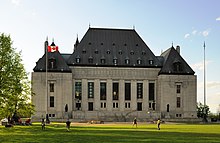
In several important cases, judges developed various tests and precedents for interpreting specific provisions of the Charter, including the Oakes test (section 1), set up out in the case R v Oakes (1986); and the Constabulary test (section fifteen), adult in Law five Canada (1999) which has since become defunct.[eighteen] Since Reference Re BC Motor Vehicle Act (1985), various approaches to defining and expanding the scope of fundamental justice (i.e., natural justice or due procedure) nether section 7 accept been adopted.[d]
Purposive and generous interpretation [edit]
In full general, courts accept embraced a purposive estimation of Charter rights. This means that since early cases, such equally Hunter v Southam (1984) and R 5 Big Chiliad Drug Mart (1985), they accept concentrated less on the traditional, limited agreement of what each correct meant when the Charter was adopted in 1982. Rather, focus has been given towards changing the telescopic of rights as appropriate to fit their broader purpose.[1] : 722, 724–25 This is tied to the generous interpretation of rights, as the purpose of the Charter provisions is assumed to exist to increment rights and freedoms of people in a variety of circumstances, at the expense of the regime powers.
Ramble scholar Peter Hogg (2003) has approved of the generous approach in some cases, although for others he argues the purpose of the provisions was not to accomplish a set of rights as broad as courts accept imagined.[1] : 722, 724–25 The arroyo has not been without its critics. Alberta politician Ted Morton and political scientist Rainer Knopff take been very critical of this phenomenon. Although they believe in the validity of the living tree doctrine, which is the basis for the approach (and the tradition term for generous interpretations of the Canadian Constitution), they debate Charter case law has been more radical. When the living tree doctrine is practical correctly, Morton and Knopff (2000) claim, "the elm remained an elm; it grew new branches merely did not transform itself into an oak or a willow." The doctrine can be used, for example, then a right is upheld even when a government threatens to violate information technology with new technology, every bit long as the essential right remains the same, but the authors claim that the courts have used the doctrine to "create new rights". As an case, the authors note that the Charter right against self-incrimination has been extended to cover scenarios in the justice organisation that had previously been unregulated by self-incrimination rights in other Canadian laws.[xix] : 46–47
Other interpretations [edit]
Another general approach to interpreting Charter rights is to consider international legal precedents with countries that have specific rights protections, such as the U.South. Nib of Rights (which had influenced aspects of the Charter) and the Constitution of South Africa. However, international precedent is only of guiding value and is non binding. For case, the SCC has referred to the Charter and the U.South. Bill of Rights as being "born to different countries in different ages and in different circumstances".[east] [1] : 232
Advancement groups frequently intervene in cases to make arguments on how to interpret the Charter. Some examples are the British Columbia Ceremonious Liberties Association, Canadian Ceremonious Liberties Association, Canadian Mental Wellness Association, Canadian Labour Congress, the Women'southward Legal Pedagogy and Action Fund (LEAF), and Real Women of Canada. The purpose of such interventions is to assist the court and to attempt to influence the courtroom to render a decision favourable to the legal interests of the group.
A further approach to the Charter, taken by the courts, is the dialogue principle, which involves greater participation past elected governments. This arroyo involves governments drafting legislation in response to court rulings and courts acknowledging the effort if the new legislation is challenged.
Comparisons with other human rights documents [edit]
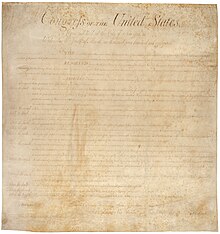
The The states Bill of Rights influenced the text of the Charter, but its rights provisions are interpreted more conservatively. Canadian civil-rights and ramble cases as compared to American cases occasionally have dissimilar outcomes because the broader Charter rights are limited by the "savings clause" of department i of the Lease as interpreted in R 5 Oakes
Some Canadian members of Parliament saw the movement to entrench a charter equally contrary to the British model of Parliamentary supremacy. Hogg (2003) has speculated that the reason for the British adoption of the Human Rights Act 1998, which allows the European Convention on Homo Rights to be enforced directly in domestic courts, is partly because they were inspired past the similar Canadian Charter.[20]
The Canadian Lease bears a number of similarities to the European Convention, specifically in relation to the limitations clauses independent in the European certificate.[21] Because of this similarity with European human rights law, the SCC turns not simply to the Us Constitution case law in interpreting the Lease, but also to European Court of Man Rights cases.
Canadian Charter vs. U.S. Neb of Rights [edit]
The core distinction between the U.South. Bill of Rights and the Canadian Charter is the existence of the limitations and notwithstanding clauses. Canadian courts have consequently interpreted each right more expansively. However, due to the limitations clause, where a violation of a right exists, the law will not necessarily grant protection of that right.[i] : 232–iii In contrast, rights nether the U.Due south. Bill are accented, thus a violation will not be found until in that location has been sufficient encroachment on those rights. The sum event is that both constitutions provide comparable protection of many rights.[1] : 232–3 Canada's "central justice" (section 7) is therefore interpreted to include more legal protections than due process, which is the U.South. equivalent.
Liberty of expression (section 2) also has a wider-ranging telescopic than the freedom of speech guaranteed under the U.South. Get-go Amendment (1A).[1] : 232–3 For instance, a form of picketing, though involving spoken language that might have otherwise been protected, was deemed equally disruptive conduct and not protected by the U.South. 1A, but was considered by the SCC in RWDSU v. Dolphin Delivery Ltd. (1986). The SCC would rule the picketing, including the disruptive conduct, as fully protected nether section 2 of the Charter, subsequently which department one would be used to argue the injunction against the picketing as just.[22]
The limitations clause has also allowed governments to enact laws that would be considered unconstitutional in the U.S. For example, the SCC has upheld some of Quebec'southward limits on the apply of English on signs and has upheld publication bans that prohibit media from mentioning the names of juvenile criminals.
The un-ratified Equal Rights Amendment in the U.S., which garnered many critics when proposed, performs a like function to that of the Charter section 28, which received no comparable opposition.[23] Still, Canadian feminists had to stage large protests to demonstrate support for the inclusion of section 28, which had not been part of the original draft of the Charter.[24] [25]
Comparisons to other documents [edit]
The International Covenant on Ceremonious and Political Rights has several parallels with the Canadian Charter, but in some cases the Covenant goes further with regard to rights in its text. For case, a correct to legal aid has been read into section 10 of the Lease (right to counsel), but the Covenant explicitly guarantees the accused need not pay "if he does non take sufficient means".[1] : 233–four
Canada'south Lease has petty to say, explicitly at least, about economical and social rights. On this point, it stands in marked contrast with the Quebec Charter of Human Rights and Freedoms and with the International Covenant on Economic, Social and Cultural Rights. There are some who feel economical rights ought to be read into the rights to security of the person (section seven) and equality rights (section fifteen) to brand the Charter similar to the Covenant.[24] The rationale is that economical rights can relate to a decent standard of living and can help the civil rights flourish in a livable environment.[24] Canadian courts, yet, have been hesitant in this area, stating that economic rights are political questions and adding that as positive rights, economic rights are of questionable legitimacy.[24]
The Charter itself influenced the Nib of Rights in the Constitution of Southward Africa.[24] The limitations clause nether section 36 of the South African constabulary has been compared to section 1 of the Charter.[21] Likewise, Jamaica's Charter of Fundamental Rights and Freedoms was likewise influenced, in office, by Canada'due south Charter.[26] [27]
The Charter and national values [edit]
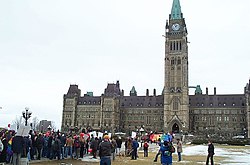
The "March of Hearts" rally for same-sex activity wedlock equality under the Charter in 2004.
The Charter was intended to exist a source of Canadian values and national unity. Every bit Professor Alan Cairns noted, "the initial federal government premise was on developing a pan-Canadian identity".[20] Pierre Trudeau (1993) himself later wrote in his Memoirs that "Canada itself" could now be defined as a "lodge where all people are equal and where they share some fundamental values based upon liberty", and that all Canadians could identify with the values of freedom and equality.[28]
The Charter 's unifying purpose was particularly important to the mobility and linguistic communication rights. Co-ordinate to author Rand Dyck (2000), some scholars believe section 23, with its minority language education rights, "was the only function of the Charter with which Pierre Trudeau was truly concerned".[29] : 442 Through the mobility and language rights, French Canadians, who have been at the middle of unity debates, are able to travel throughout all Canada and receive government and educational services in their own linguistic communication. Hence, they are not confined to Quebec (the merely province where they form the majority and where most of their population is based), which would polarize the country forth regional lines. The Charter was also supposed to standardize previously diverse laws throughout the country and gear them towards a single principle of freedom.[i] : 704–5
Former premier of Ontario Bob Rae has stated that the Charter "functions equally a symbol for all Canadians" in do considering information technology represents the core value of freedom.[xx] Academic Peter Russell has been more skeptical of the Charter 's value in this field. Cairns, who feels the Lease is the most important constitutional document to many Canadians, and that the Charter was meant to shape the Canadian identity, has also expressed concern that groups within society encounter sure provisions as belonging to them lonely rather than to all Canadians.[20] Information technology has also been noted that issues like abortion and pornography, raised by the Lease, tend to be controversial.[1] : 704–v Yet, opinion polls in 2002 showed Canadians felt the Lease significantly represented Canada, although many were unaware of the document's actual contents.[30]
The only values mentioned by the Charter's preamble are recognition of the supremacy of God and the rule of law, but these take been controversial and of small legal consequence. In 1999, MP Svend Robinson brought forward a failed proposal earlier the Firm of Eatables of Canada that would accept amended the Charter by removing the mention of God, as he felt it did not reflect Canada's multifariousness.
Section 27 also recognizes a value of multiculturalism. In 2002, polls found 86% of Canadians approved of this department.[31]
Criticism [edit]
While the Lease has enjoyed a great deal of popularity, with 82 percentage of Canadians describing it as a good affair in opinion polls in 1987 and 1999,[xx] the document has also been subject to published criticisms from both sides of the political spectrum. 1 left-wing critic is professor Michael Mandel (1989),[f] who wrote that in comparison to politicians, judges practice not take to be as sensitive to the will of the electorate, nor do they have to make sure their decisions are hands understandable to the average Canadian citizen. This, in Mandel'due south view, limits republic.[29] : 446 Mandel has likewise asserted that the Charter makes Canada more like the United states, especially by serving corporate rights and individual rights rather than group rights and social rights.[29] : 446 He has argued that at that place are several things that should be included in the Lease, such as a right to health care and a basic right to complimentary didactics. Hence, the perceived Americanization of Canadian politics is seen equally coming at the expense of values more than important for Canadians.[29] : 446 The labour movement has been disappointed in the reluctance of the courts to use the Charter to support diverse forms of union activeness, such as the "correct to strike".[ needs update ]
Conservative critics Morton and Knopff (2000) have raised several concerns about the Lease, notably by alleging that the federal authorities has used information technology to limit provincial powers by allying with diverse rights claimants and interest groups. In their book The Charter Revolution & the Court Party (2000), Morton and Knopff limited their suspicions of this alliance in detail, accusing the Pierre Trudeau and Chrétien governments of funding litigious groups. For example, these governments used the Court Challenges Programme to support minority language educational rights claims. Morton and Knopff as well assert that crown counsel has intentionally lost cases in which the government was taken to court for allegedly violating rights,[g] specially gay rights and women'due south rights.[nineteen] : 95
Political scientist Rand Dyck (2000), in observing these criticisms, notes that while judges accept had their scope of review widened, they have notwithstanding upheld most laws challenged on Charter grounds. With regard to litigious involvement groups, Dyck points out that "the tape is not as clear every bit Morton and Knopff imply. All such groups have experienced wins and losses."[29] : 448
Political philosopher Charles Blattberg (2003) has criticized the Charter for contributing to the fragmentation of the country, at both the individual and group levels. In encouraging discourse based upon rights, Blattberg claims the Lease injects an adversarial spirit into Canadian politics, making it difficult to realize the common practiced. Blattberg as well claims that the Charter undercuts the Canadian political community since information technology is ultimately a cosmopolitan document. Finally, he argues that people would be more motivated to uphold individual liberties if they were expressed with terms that are much "thicker" (less abstruse) than rights.[32]
See also [edit]
- Canadian Bill of Rights
- Canadian Human Rights Act
- History of Canada
- Man rights in Canada
- Quebec Charter of Human Rights and Freedoms
- Supreme Courtroom of Canada
- Veterans' Bill of Rights
- List of Supreme Court of Canada cases (Dickson Courtroom)
- List of Supreme Courtroom of Canada cases (Lamer Courtroom)
- List of Supreme Court of Canada cases (McLachlin Court)
References [edit]
Footnotes [edit]
- ^ R. v. Drybones (1969), [1970] Due south.C.R. 282—the ane and only federal police declared inoperative past the Supreme Court based on the Bill of Rights. See: Canada (AG) v. Lavell, [1974] S.C.R. 1349—example of narrow interpretation by the SC.
- ^ Alberta's use of the notwithstanding clause is of no strength or effect, since the definition of marriage is under federal and not provincial jurisdiction.[v]
- ^ This would be the case in Doucet-Boudreau v. Nova Scotia (Minister of Education).
- ^ For more than data, run into the manufactures on each Charter section.
- ^ The case quoted in Hogg (2003:732) is R 5 Rahey (1987) by Gérard La Forest.
- ^ Dyck (2000:446) summarizes Mandel, Michael. 1994 [1989]. The Lease of Rights and the Legalization of Politics in Canada (revised ed.). Toronto: Wall and Thompson.
- ^ Morton and Knopff (2000) mutter about crown counsels on p.117.
Citations [edit]
- ^ a b c d e f thousand h i j k Hogg, Peter West. 2003. Constitutional Law of Canada (student ed.). Scarborough, ON: Thomson Canada Express. p. 689.
- ^ R v Oakes, [1986] i SCR 103, 1986 CanLII 46 at paras 69–lxx.
- ^ Scoffield, Heather. thirteen September 2010. "Ottawa rules out invoking notwithstanding clause to cease migrant ships." Canadian Press. [news article].
- ^ Marriage Act, R.S.A. 2000, c. G-5. Archived 2007-01-13 at the Wayback Machine, accessed on 10 March 2006.
- ^ McKnight, Peter. 21 Jan 2006. "Nevertheless what?" The Vancouver Lord's day. p. C.4. [news article].
- ^ Parliamentary Information and Enquiry Service. 2006. "The Withal Clause of the Charter." Library of Parliament, prepared by D. Johansen (1989), revised May 2005. Archived 2006-11-15 at the Wayback Machine, accessed on 7 August 2006.
- ^ "Sources of Canadian Law" [archived]. Department of Justice Canada. Retrieved March 20, 2006.
- ^ Constitutional Law Grouping. Canadian Constitutional Law (tertiary ed.). Toronto: Edmond Montgomery Publications. p. 635.
- ^ Hogg, Peter W. 1982. Canada Act 1982 Annotated. Toronto: Carswell Company.
- ^ United States of America 5. Cotroni; U.s. five. El Zein [1989] 1 S.C.R. 1469.
- ^ Strayer, Barry L. "My Constitutional Summer of 1967" [archive] Reflections on the Charter, Department of Justice Canada. Retrieved March 18, 2006.
- ^ "Charting the Hereafter: Canada's New Constitution". CBC Athenaeum. CBC/Radio-Canada. Retrieved 2010-06-30 .
- ^ a b c d e f Weinrib, Lorraine E. 1998. "Trudeau and the Canadian Lease of Rights and Freedoms: A Question of Ramble Maturation", in Trudeau'south Shadow: The Life and Legacy of Pierre Elliott Trudeau, edited past A. Cohen and J. L. Granatstein. Toronto: Vintage Canada.
- ^ Johansen, David. 1991. "Property Rights and the Constitution." Law and Regime Division. Library of Parliament.
- ^ CBC Learning. 2001. "The Night of Long Knives" [TV episode], Canada: A People's History. CAN: CBC/Radio-Canada. Retrieved April 8, 2006.
- ^ CBC News. 5 November 1981. "Patriation" [news circulate]. CBC Archives. CA: CBC/Radio-Canada. Retrieved Baronial 8, 2006. [beginning at 4:04].
- ^ Behiels, Michael D. "Who Speaks for Canada? Trudeau and the Constitutional Crisis." In Trudeau's Shadow: The Life and Legacy of Pierre Elliott Trudeau. p. 346.
- ^ R. v. Kapp, 2008 SCC 41, [2008] 2 SCR 483
- ^ a b Morton, Ted, and Knopff, Rainer (2000). The Charter Revolution & the Court Party. Toronto: Broadview Press.
- ^ a b c d east Saunders, Philip (April 2002). "The Charter at 20". CBC News Online. CBC/Radio-Canada. Archived from the original on vii March 2006. Retrieved March 17, 2006.
- ^ a b Dickson, Brice. 11 Nov 1999. "Human Rights in the 21st Century" [lecture]. Amnesty International. Belfast: Queen's University.
- ^ Manfredi, Christopher P. 1992. "The Canadian Supreme Courtroom and American judicial review: United States constitutional jurisprudence and the Canadian Charter of Rights and Freedoms." American Journal of Comparative Constabulary 40(ane):12–13.
- ^ "Women on the Move in Canada" (1993), Women's International Network News Summertime 19(3), p. 71.
- ^ a b c d e Lugtig, Sarah, and Debra Parkes, 2002. "Where do we go from hither?" Herizons 15(iv). p.14.
- ^ Anderson, Doris. 2005. "Canadian Women and the Charter of Rights." National Journal of Constitutional Law 19. p. 369.
- ^ Joint Select Committee. 2011. "Written report of the Joint Select Committee on its Deliberations on the Nib Entitled An Act to Ameliorate the Constitution of Jamaica to Provide for a Charter of Rights and for Connected Matters." Government of Jamaica.
- ^ Mukulu, Matondo (2011). "Rights and responsibilities under the charter". The Gleaner (News commodity). Jamaica.
- ^ Trudeau, Pierre Elliott. 1993. Memoirs. Toronto: McClelland & Stewart. Pp. 322–3.
- ^ a b c d e Dyck, Rand. 2000. Canadian Politics: Critical Approaches (3rd ed.). Scarborough, ON: Nelson Thomson Learning.
- ^ Byfield, Joanne. 2002. "The right to be ignorant." Written report Newsmagazine (national ed.) 29(24):56.
- ^ Tyler, Tracey. 12 Apr 2002 "Support for Charter runs potent: Survey; Approval highest in Quebec on 20-twelvemonth-onetime rights law." Toronto Star. p. A07.
- ^ Blattberg, Charles. 2003. Shall We Dance? A Patriotic Politics for Canada. Montreal: McGill-Queen'south University Press. especially pp. 83–94.
Farther reading [edit]
- Beaudoin, One thousand., and E. Ratushny. 1989. The Canadian Charter of Rights and Freedoms. (2nd ed.). Toronto: Carswell.
- Blackness-Branch, Jonathan L. 1995. Making sense of the Canadian Lease of Rights and Freedoms. Canadian Instruction Association. ISBN 0-920315-78-X
- Department of Justice Canada. 2019. "Examples of Charter-related cases." Canada'south Organisation of Justice. Section of Justice Canada. Web.
- Hogg, Peter West. 2002. Constitutional law of Canada (quaternary ed.), with Supplement to Constitutional Law of Canada. Scarborough: Carswell.
- Humphrey, J. P. 1984. Homo Rights and the United Nations: A Neat Chance. New York: Transnational Publishers.
- Magnet, J.E. 2001. Constitutional Law (8th ed.).
- Silver, Cindy. 1995?. Family Autonomy and the Charter of Rights: Protecting Parental Liberty in a Child-Centred Legal Organization, in series, Discussion Paper [of] the Heart for Renewal in Public Policy 3. Gloucester, ON: Centre for Renewal in Public Policy. p. 27.
External links [edit]
- Canadian Lease of Rights and Freedoms – the Charter, via Department of Justice Canada
- Canadian Charter of Rights and Freedoms – the Charter, via Department of Justice Canada (Archived)
- Charterpedia – online encyclopedia about the Charter, via Section of Justice Canada
- Building a Just Club: A Retrospective of Canadian Rights and Freedoms – via Library and Archives Canada
- Charter of Rights Decisions Digest – via Canadian Legal Information Plant
- Constitutional Law of Canada – via Professor Joseph East. Magnet, Academy of Ottawa
- Primal Freedoms: The Charter of Rights and Freedoms – Charter of Rights and Freedoms, includes video, sound, and the Charter in over 10 languages
Source: https://en.wikipedia.org/wiki/Canadian_Charter_of_Rights_and_Freedoms
0 Response to "America Land I Love Section 32 Review Charter Oak"
ارسال یک نظر