what is the atomic number equal to in an atom
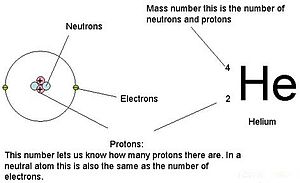
An explanation of the superscripts and subscripts seen in atomic number notation. Atomic number is the number of protons, and therefore also the total positive accuse, in the atomic nucleus.
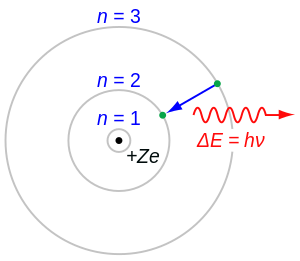
The Rutherford–Bohr model of the hydrogen cantlet ( Z = 1) or a hydrogen-like ion ( Z > 1). In this model it is an essential feature that the photon energy (or frequency) of the electromagnetic radiation emitted (shown) when an electron jumps from one orbital to another exist proportional to the mathematical foursquare of diminutive charge ( Z2 ). Experimental measurement by Henry Moseley of this radiation for many elements (from Z = 13 to 92) showed the results every bit predicted by Bohr. Both the concept of atomic number and the Bohr model were thereby given scientific credence.
The diminutive number or nuclear charge number (symbol Z) of a chemical element is the accuse number of an diminutive nucleus. For ordinary nuclei, this is equal to the proton number (n p) or the number of protons found in the nucleus for every atom of that chemical element. The atomic number can be used to uniquely identify ordinary chemical elements. In an ordinary uncharged atom, the diminutive number is besides equal to the number of electrons.
For an ordinary atom, the sum of the atomic number Z and the neutron number N gives the atomic mass number A for the atom. Since protons and neutrons have approximately the aforementioned mass (and the mass of the electrons is negligible for many purposes) and the mass defect of the nucleon binding is always small compared to the nucleon mass, the atomic mass of whatever cantlet, when expressed in unified diminutive mass units (making a quantity called the "relative isotopic mass"), is inside ane% of the whole number A.
Atoms with the same atomic number just different neutron numbers, and hence different mass numbers, are known every bit isotopes. A trivial more three-quarters of naturally occurring elements be every bit a mixture of isotopes (see monoisotopic elements), and the average isotopic mass of an isotopic mixture for an element (called the relative atomic mass) in a defined environment on Globe, determines the chemical element'south standard diminutive weight. Historically, it was these diminutive weights of elements (in comparison to hydrogen) that were the quantities measurable by chemists in the 19th century.
The conventional symbol Z comes from the German language word Zahl 'number', which, before the modern synthesis of ideas from chemistry and physics, merely denoted an element's numerical place in the periodic table, whose order was then approximately, merely non completely, consistent with the order of the elements past diminutive weights. Only after 1915, with the proposition and show that this Z number was also the nuclear accuse and a physical characteristic of atoms, did the word Atomzahl (and its English equivalent atomic number) come into common utilise in this context.
History [edit]
The periodic table and a natural number for each element [edit]
Loosely speaking, the being or construction of a periodic table of elements creates an ordering of the elements, then they can be numbered in guild.
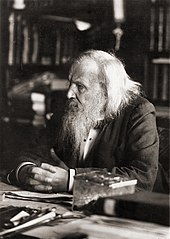
Dmitri Mendeleev claimed that he arranged his starting time periodic tables (start published on March 6, 1869) in order of atomic weight ("Atomgewicht").[1] Notwithstanding, in consideration of the elements' observed chemic properties, he changed the club slightly and placed tellurium (atomic weight 127.6) alee of iodine (atomic weight 126.9).[one] [2] This placement is consequent with the modern practice of ordering the elements past proton number, Z, but that number was not known or suspected at the time.

A elementary numbering based on periodic table position was never entirely satisfactory, however. Besides the instance of iodine and tellurium, later several other pairs of elements (such as argon and potassium, cobalt and nickel) were known to have nearly identical or reversed atomic weights, thus requiring their placement in the periodic tabular array to exist adamant by their chemical properties. However the gradual identification of more and more chemically similar lanthanide elements, whose atomic number was not obvious, led to inconsistency and uncertainty in the periodic numbering of elements at least from lutetium (element 71) onward (hafnium was not known at this time).
The Rutherford-Bohr model and van den Broek [edit]
In 1911, Ernest Rutherford gave a model of the atom in which a central nucleus held most of the atom's mass and a positive charge which, in units of the electron'due south accuse, was to exist approximately equal to one-half of the atom's diminutive weight, expressed in numbers of hydrogen atoms. This central charge would thus be approximately one-half the diminutive weight (though it was almost 25% different from the diminutive number of gold (Z = 79, A = 197), the single chemical element from which Rutherford made his guess). Nevertheless, in spite of Rutherford'south interpretation that gold had a primal charge of about 100 (but was element Z = 79 on the periodic table), a month later on Rutherford'southward paper appeared, Antonius van den Broek first formally suggested that the central accuse and number of electrons in an atom was exactly equal to its place in the periodic table (as well known as element number, atomic number, and symbolized Z). This proved eventually to be the example.
Moseley's 1913 experiment [edit]
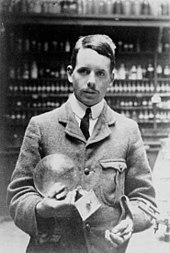
The experimental position improved dramatically after research by Henry Moseley in 1913.[3] Moseley, later on discussions with Bohr who was at the aforementioned lab (and who had used Van den Broek's hypothesis in his Bohr model of the atom), decided to test Van den Broek'south and Bohr'south hypothesis directly, by seeing if spectral lines emitted from excited atoms fitted the Bohr theory's postulation that the frequency of the spectral lines be proportional to the foursquare of Z.
To do this, Moseley measured the wavelengths of the innermost photon transitions (Thousand and L lines) produced by the elements from aluminum (Z = 13) to gold (Z = 79) used as a series of movable anodic targets within an x-ray tube.[4] The foursquare root of the frequency of these photons (x-rays) increased from one target to the next in an arithmetics progression. This led to the determination (Moseley's police force) that the diminutive number does closely correspond (with an beginning of ane unit of measurement for M-lines, in Moseley'southward work) to the calculated electric charge of the nucleus, i.due east. the chemical element number Z. Amidst other things, Moseley demonstrated that the lanthanide series (from lanthanum to lutetium inclusive) must accept 15 members—no fewer and no more—which was far from obvious from known chemistry at that time.
Missing elements [edit]
After Moseley'south death in 1915, the diminutive numbers of all known elements from hydrogen to uranium (Z = 92) were examined by his method. At that place were seven elements (with Z < 92) which were non found and therefore identified as nonetheless undiscovered, corresponding to diminutive numbers 43, 61, 72, 75, 85, 87 and 91.[5] From 1918 to 1947, all vii of these missing elements were discovered.[half dozen] By this time, the first four transuranium elements had too been discovered, then that the periodic table was consummate with no gaps as far as curium (Z = 96).
The proton and the idea of nuclear electrons [edit]
In 1915, the reason for nuclear charge being quantized in units of Z, which were now recognized to be the same as the element number, was not understood. An quondam idea called Prout's hypothesis had postulated that the elements were all made of residues (or "protyles") of the lightest chemical element hydrogen, which in the Bohr-Rutherford model had a unmarried electron and a nuclear charge of i. However, as early every bit 1907, Rutherford and Thomas Royds had shown that alpha particles, which had a charge of +ii, were the nuclei of helium atoms, which had a mass iv times that of hydrogen, not ii times. If Prout's hypothesis were true, something had to be neutralizing some of the charge of the hydrogen nuclei present in the nuclei of heavier atoms.
In 1917, Rutherford succeeded in generating hydrogen nuclei from a nuclear reaction between alpha particles and nitrogen gas,[7] and believed he had proven Prout'south constabulary. He called the new heavy nuclear particles protons in 1920 (alternate names being proutons and protyles). It had been immediately apparent from the work of Moseley that the nuclei of heavy atoms take more than twice every bit much mass every bit would exist expected from their beingness made of hydrogen nuclei, and thus there was required a hypothesis for the neutralization of the extra protons presumed nowadays in all heavy nuclei. A helium nucleus was presumed to be composed of 4 protons plus ii "nuclear electrons" (electrons jump inside the nucleus) to cancel 2 of the charges. At the other stop of the periodic tabular array, a nucleus of gold with a mass 197 times that of hydrogen was thought to contain 118 nuclear electrons in the nucleus to give it a residuum charge of +79, consequent with its diminutive number.
The discovery of the neutron makes Z the proton number [edit]
All consideration of nuclear electrons ended with James Chadwick's discovery of the neutron in 1932. An atom of golden now was seen as containing 118 neutrons rather than 118 nuclear electrons, and its positive nuclear charge now was realized to come entirely from a content of 79 protons. Since Moseley had previously shown that the atomic number Z of an element equals this positive accuse, it was now clear that Z is identical to the number of protons of its nuclei.
Chemical properties [edit]
Each element has a specific set of chemical properties as a consequence of the number of electrons nowadays in the neutral atom, which is Z (the atomic number). The configuration of these electrons follows from the principles of quantum mechanics. The number of electrons in each element's electron shells, peculiarly the outermost valence shell, is the primary factor in determining its chemical bonding behavior. Hence, information technology is the atomic number alone that determines the chemical backdrop of an element; and it is for this reason that an element can exist defined as consisting of any mixture of atoms with a given atomic number.
New elements [edit]
The quest for new elements is unremarkably described using diminutive numbers. As of 2022, all elements with atomic numbers 1 to 118 have been observed. Synthesis of new elements is accomplished by bombarding target atoms of heavy elements with ions, such that the sum of the diminutive numbers of the target and ion elements equals the diminutive number of the element being created. In general, the half-life of a nuclide becomes shorter as atomic number increases,[ citation needed ] though undiscovered nuclides with certain "magic" numbers of protons and neutrons may have relatively longer half-lives and comprise an island of stability.
A hypothetical element composed just of neutrons has also been proposed and would have atomic number 0.
See also [edit]
- Effective diminutive number
- Mass number
- Neutron number
- Exotic atom
- Diminutive theory
- Chemical element
- History of the periodic table
- List of elements by atomic number
- Prout'due south hypothesis
References [edit]
- ^ a b The Periodic Table of Elements, American Institute of Physics
- ^ The Evolution of the Periodic Table, Royal Society of Chemistry
- ^ Ordering the Elements in the Periodic Table, Imperial Chemical Society
- ^ Moseley, H.G.J. (1913). "XCIII.The loftier-frequency spectra of the elements". Philosophical Magazine. Series vi. 26 (156): 1024–1034. doi:x.1080/14786441308635052. Archived from the original on 22 January 2010.
- ^ Eric Scerri, A tale of seven elements, (Oxford Academy Printing 2013) ISBN 978-0-19-539131-2, p.47
- ^ Scerri chaps. iii–nine (one affiliate per chemical element)
- ^ Ernest Rutherford | NZHistory.net.nz, New Zealand history online. Nzhistory.net.nz (19 October 1937). Retrieved on 2011-01-26.
Source: https://en.wikipedia.org/wiki/Atomic_number
0 Response to "what is the atomic number equal to in an atom"
ارسال یک نظر